CO2 Laser Treatment in NYC
Expert Fractional CO2 Laser Resurfacing by a Board-Certified Dermatologist in Manhattan
The Gold Standard in Skin Resurfacing
Performed Exclusively by Dr. Arash Akhavan at Our Manhattan Practice
Medically reviewed by Arash Akhavan, MD, FAAD | Board-Certified Dermatologist | Founder, The Dermatology and Laser Group, New York City | Faculty, Mount Sinai Department of Dermatology
Last Medically Reviewed: March 11, 2026
CO2 laser resurfacing remains the single most powerful treatment available for dramatically transforming skin texture, tone, and firmness — and it is one of the most technique-dependent procedures in all of cosmetic dermatology. The margin between an outstanding result and a mediocre one comes down entirely to the physician holding the handpiece.
At The Dermatology and Laser Group on the Upper East Side of Manhattan, board-certified dermatologist Dr. Arash Akhavan has performed CO2 laser treatments in NYC on thousands of patients seeking transformative improvement for fine lines, wrinkles, acne scars, sun damage, and uneven skin texture. As a nationally recognized expert in cosmetic dermatology — cited by Allure, Vogue, The New York Times, and Harper’s Bazaar — Arash Akhavan, MD combines deep clinical training with an artist’s eye, customizing every fractional CO2 laser session to each patient’s skin type, concerns, and goals.
Our Midtown Manhattan practice serves patients throughout New York City, the Upper East Side, and the greater New York area who expect a premium, expert-led experience with results that speak for themselves.

As Featured In:
Over 300 media appearances as a national expert in cosmetic dermatology and body contouring.


How Fractional Laser Technology Resurfaces and Rebuilds Skin
CO2 laser resurfacing uses concentrated beams of carbon dioxide light energy to precisely vaporize thin layers of damaged skin. The term “fractional” refers to the laser’s ability to treat a fraction of the skin’s surface at a time — creating thousands of microscopic treatment zones while leaving surrounding tissue completely intact. This triggers a powerful wound-healing cascade, stimulating robust new collagen and elastin production deep within the dermis. According to research published in the Journal of the American Academy of Dermatology, fractional CO2 laser produces measurable increases in dermal collagen density that continue developing for up to 12 months after a single session.
Unlike non-ablative lasers (such as Fraxel or ResurFX) that work beneath the surface without removing tissue, ablative CO2 laser physically resurfaces the skin — which is what makes it the most effective laser available for significant concerns. It is also what makes the skill and judgment of the provider so critical.
“There is no autopilot with CO2 laser,” explains Dr. Arash Akhavan. “Every pass I make is a decision — how deep, how dense, how much energy to deliver in that specific zone. A millimeter in the wrong direction or a setting that’s too aggressive for a patient’s skin type can mean the difference between a beautiful result and a complication. That is why I perform every treatment myself.”
At our Manhattan practice, Dr. Akhavan uses the AcuPulse CO2 Laser by Lumenis — featuring both DeepFX (for deep collagen remodeling) and ActiveFX (for surface resurfacing). This dual-mode platform, developed by Lumenis, allows him to precisely control depth, density, pattern, and energy for each treatment zone — a level of customization that is essential because no two patients’ skin responds identically to laser energy.

Skin Concerns We Treat with Fractional Resurfacing
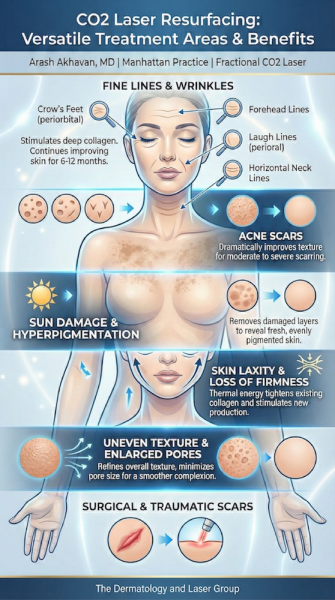
CO2 laser resurfacing is one of the most versatile treatments in cosmetic dermatology. At our Manhattan practice, Dr. Arash Akhavan uses fractional CO2 laser to treat a wide range of concerns across the face, neck, chest, and hands:
Fine Lines and Wrinkles — CO2 laser is exceptionally effective for perioral lines (around the mouth), periorbital wrinkles (around the eyes), forehead creases, and neck lines. It stimulates deep collagen remodeling that continues improving skin for 6–12 months after treatment.
Acne Scars — For patients with moderate to severe acne scarring — including boxcar scars, rolling scars, and ice pick scars — ablative CO2 laser can dramatically improve skin texture. Published clinical studies report 50–70% improvement in scar appearance following treatment, with some patients achieving even greater improvement after a second session.
Sun Damage and Hyperpigmentation — Years of UV exposure cause irregular pigmentation, rough texture, and precancerous actinic keratoses. CO2 laser removes damaged surface layers to reveal fresh, evenly toned skin beneath.
Skin Laxity and Loss of Firmness — The thermal energy delivered by CO2 laser tightens existing collagen fibers while stimulating new collagen production, producing visibly firmer skin — particularly along the jawline, neck, and under-eye area.
Uneven Texture and Enlarged Pores — CO2 resurfacing refines overall skin texture, minimizes pore size, and creates a smoother, more luminous complexion.
Surgical and Traumatic Scars — CO2 laser can soften, flatten, and significantly improve the appearance of raised or irregular scars on the face and body.
The Patient Experience: From Consultation Through Recovery
At The Dermatology and Laser Group, your CO2 laser experience is designed to feel comfortable, informed, and genuinely personalized from the moment you arrive at our Manhattan office.
Your Consultation: Every treatment begins with a thorough one-on-one evaluation with Arash Akhavan, MD, FAAD. He examines your skin under magnification, discusses your concerns and goals, reviews your medical history, and determines the precise laser settings for your skin type and needs. “I spend as much time on the consultation as I do on the treatment itself,” says Dr. Akhavan. “Understanding what a patient actually wants — not just what they say they want — is where the real artistry begins.”
Pre-Treatment Preparation: Depending on your skin, Dr. Akhavan may prescribe a preparatory regimen that could include tretinoin, antiviral medication (to prevent cold sore activation), and medical-grade skincare products to optimize your skin for treatment.
During Treatment: CO2 laser resurfacing typically takes 30 to 60 minutes. A topical numbing cream is applied approximately 45 minutes beforehand, and we have both Pro-NOX (inhaled nitrous oxide) and Zimmer Cooling available for added comfort. Dr. Arash Akhavan personally performs every CO2 laser treatment — your care is never delegated to a technician or physician assistant.
Immediately After: Your skin will appear red and feel warm, similar to a moderate sunburn. Our team applies a healing ointment and provides you with a comprehensive post-treatment care kit with detailed day-by-day recovery instructions.
Recovery Timeline: Most patients experience 7 to 10 days of active healing, with redness and some peeling. By day 10, most feel comfortable returning to work with mineral makeup. Residual pinkness typically fades within 2 to 4 weeks. Full collagen remodeling continues for 3 to 12 months — meaning your skin keeps improving long after the treatment.
CO2 Laser Before and After Images


Transparent Pricing for CO2 Laser Resurfacing
Manufacturer-Authorized Lowest Price
The standard cost for CO2 laser resurfacing at The Dermatology and Laser Group in New York City starts at $1,800 for a small treatment area. Below is our complete, transparent pricing for treatments performed by Arash Akhavan, MD at our Manhattan practice — the price shown is the price you pay, with no hidden fees:
| Treatment Area | Price |
|---|---|
| Full Face | $3,500 |
| Neck | $3,000 |
| Décolletage (Chest) | $4,000 |
| Small Area (e.g., individual scar) |
$1,800 |
Combination Discount
Treating two areas in the same session? The smaller area is discounted 50%. For example, a Face + Neck treatment is $5,000 — saving you $1,500.
For other treatment areas — including hands, arms, or other body areas — we are happy to provide a personalized quote during your consultation.
Combination Discount: Treating two areas in the same session? The smaller area is discounted 50%. For example, a Face + Neck treatment is $5,000 — saving you $1,500. For other treatment areas — including hands, arms, or other body areas — we are happy to provide a personalized quote during your consultation.
While many patients achieve dramatic results from a single CO2 laser session, some concerns — particularly deep acne scars — may benefit from a series of two or three treatments spaced several months apart. Dr. Arash Akhavan will recommend the ideal treatment plan for your goals during your consultation.
CO2 laser is one of the most technique-dependent procedures in cosmetic dermatology. When comparing costs across providers, keep in mind that the skill, experience, and board certification of your dermatologist directly impacts both your results and your safety. Every treatment at our practice is performed personally by Dr. Akhavan — never delegated to a technician, nurse, or PA.
Patient Testimonials and Reviews
Why Patients Choose Dr. Arash Akhavan for CO2 Laser in New York City
Choosing the right provider for CO2 laser resurfacing is arguably the most important decision you will make in this process. The difference between an exceptional result and a disappointing one comes down to the skill, experience, and aesthetic judgment of your dermatologist.
Dr. Arash Akhavan is a board-certified dermatologist and nationally recognized expert in cosmetic dermatology. He has been cited as a leading authority on skin rejuvenation, laser treatments, and cosmetic procedures by publications including Allure, Vogue, The New York Times, and Harper’s Bazaar.
-
Board-Certified Dermatologist
Not a general practitioner or aesthetician. Board-certified training in skin disease and cosmetic procedures.
-
Personally Performs Every Treatment
Your CO2 laser treatment will never be delegated.
-
Customized Treatment Parameters
No two treatments are identical. Dr. Arash Akhavan adjusts depth, density, pattern, and energy level for each patient.
-
Comprehensive Pre- and Post-Care
Detailed protocols and care kits, with direct access to our team throughout recovery.
-
Luxury Patient Experience
Our Manhattan practice is designed for patients who expect the highest standard of care, privacy, and comfort.
Comparing Skin Resurfacing Treatments: Clinical Results and Recovery
CO2 laser resurfacing delivers the most dramatic improvement in a single session compared to other resurfacing options. The table below compares four common treatments across key clinical factors to help you understand where each option fits based on your concerns and lifestyle.
| Clinical Factor | Fractional CO2 | Fraxel Dual | Chemical Peel | Microneedling + PRP |
|---|---|---|---|---|
| Mechanism | Ablative fractional resurfacing | Non-ablative fractional | Chemical exfoliation | Controlled micro-injury + growth factors |
| Best For | Deep wrinkles, acne scars, sun damage, laxity | Mild pigmentation, fine lines, early sun damage | Superficial pigmentation, mild texture | Mild scarring, fine lines, pore refinement |
| Clinical Results | Most dramatic single-session improvement | Moderate cumulative improvement | Mild to moderate | Mild to moderate |
| Typical Sessions | 1–2 | 3–6 | 5–10 | 3–6 |
| Downtime | 7–10 days | 3–5 days | 6–8 days | 2–5 days |
| Collagen Stimulation | Strongest (up to 12 months) | Moderate | Mild to moderate | Moderate |
| NYC Cost Range | $1,800–$4,000 | $1,000–$2,500 | $500–$2,000 | $850–$3,000 |
| Fitzpatrick Types | I–IV (with modified protocol) | I–V | I–VI (varies by depth) | I–VI |
Understanding Ablative vs. Non-Ablative Laser Technology
The distinction between ablative and non-ablative lasers is one of the most important concepts in laser skin resurfacing. Ablative lasers — including CO2 and Erbium — physically vaporize damaged tissue, which triggers a more aggressive healing response and produces more dramatic results. Non-ablative lasers (like Fraxel Dual, ResurFX, and certain picosecond lasers) heat tissue beneath the surface without removing it, offering gentler treatment with less downtime but also less dramatic improvement.
Fractional CO2 laser resurfacing represents the most advanced form of ablative treatment. The “fractional” delivery creates a grid of microscopic treatment columns — each one penetrating to a precisely controlled depth — while leaving bridges of untreated skin between them. These intact bridges are what make recovery faster and safer compared to older, fully ablative CO2 lasers that removed 100% of the skin surface.
The AcuPulse CO2 Laser by Lumenis that Arash Akhavan, MD, FAAD uses features dual scanning modes: DeepFX penetrates deeper into the dermis for maximum collagen remodeling (ideal for acne scars and deeper wrinkles), while ActiveFX treats the superficial epidermis for surface-level renewal (ideal for sun damage, texture, and pigmentation). Dr. Akhavan often combines both modes in a single session, tailoring the ratio to each patient’s specific needs — a technique that requires significant clinical experience to execute safely and effectively.
Treating Diverse Skin Types with Precision and Safety
One of the most important considerations in CO2 laser resurfacing is the patient’s skin type, classified using the Fitzpatrick Scale (types I through VI). Lighter skin types (I–III) have traditionally been considered the best candidates for aggressive CO2 laser treatment, and some providers still claim that CO2 laser “can only be performed on lighter skin tones.” This is an oversimplification that Dr. Akhavan encounters frequently.
“The Fitzpatrick Scale gives us a starting point, not an absolute rule,” explains Arash Akhavan, MD. “With the right technology, the right settings, and the right pre- and post-care protocol, many patients with medium skin tones can achieve excellent results safely. The key is knowing exactly how to modify the approach — and having enough experience to read the skin’s response in real time during treatment.”
At our NYC practice, Dr. Arash Akhavan has extensive experience treating patients across a range of skin types and ethnic backgrounds. For patients with darker skin tones (Fitzpatrick types IV and selected type V patients), he may adjust the energy settings, reduce the treatment density, extend the interval between any needed follow-up sessions, or incorporate medical-grade pre- and post-treatment skin preparation designed to minimize the risk of post-inflammatory hyperpigmentation.
During your consultation, Dr. Akhavan will personally evaluate your skin type and tone, discuss any concerns related to pigmentation or scarring history, and create a treatment plan tailored to maximize your results while prioritizing safety above all else.
Frequently Asked Questions About Treatment
For patients seeking the most dramatic improvement in wrinkles, acne scars, sun damage, or overall skin texture, CO2 laser resurfacing is widely considered the gold standard in dermatology. No other single treatment produces the same level of collagen remodeling and skin renewal. Most patients describe their results as transformative, with improvements that continue developing for 3 to 12 months as new collagen matures. A 2022 systematic review published in Dermatologic Surgery confirmed that fractional CO2 laser remains the most effective ablative resurfacing modality for photodamage and scarring. The key is choosing an experienced, board-certified dermatologist like Dr. Arash Akhavan who customizes treatment parameters to maximize results while minimizing risk.
At The Dermatology and Laser Group, CO2 laser resurfacing starts at $1,800 for a small treatment area such as an individual scar. Full face treatment is $3,500, neck is $3,000, and décolletage is $4,000. When combining two areas in the same session, the smaller area is discounted 50% — for example, a face and neck treatment is $5,000. All treatments are performed personally by Arash Akhavan, MD, FAAD. For other areas, we provide a personalized quote during your consultation.
The primary consideration is the recovery period — most patients experience 7 to 10 days of redness, swelling, and peeling before feeling comfortable returning to their normal routine. There is also a small risk of temporary post-inflammatory hyperpigmentation (darkening) or hypopigmentation (lightening), particularly in patients with medium to darker skin tones, which is why choosing an experienced provider is essential. Additionally, CO2 laser settings must be carefully calibrated for each patient — aggressive treatment on skin that does not require it can produce excessive collagen response. Dr. Arash Akhavan carefully evaluates every patient’s skin type, medical history, and goals before recommending treatment parameters.
Most patients can expect 7 to 10 days of active healing. During the first few days, the skin will feel tight and appear red, with some oozing and crusting that gradually resolves. By day 10, most patients feel comfortable returning to work with mineral makeup to cover residual pinkness. The pink tone typically fades completely within 2 to 4 weeks. Arash Akhavan, MD provides every patient with a detailed post-care kit and day-by-day recovery protocol, and our team is available throughout recovery for any questions.
Most adults in good general health who want to address wrinkles, acne scars, sun damage, or skin laxity are good candidates. During your consultation, Dr. Akhavan will assess your skin type using the Fitzpatrick Scale, review current medications, medical history, and aesthetic goals. CO2 laser is most commonly performed on Fitzpatrick skin types I through IV. Patients with active skin infections in the treatment area, a history of keloid scarring, those currently using isotretinoin, or those who are pregnant are generally not candidates. In some cases, a modified protocol can safely achieve excellent results for patients who might otherwise be considered borderline candidates.
Advances in fractional CO2 technology — particularly the AcuPulse by Lumenis platform used at our NYC practice — combined with expert technique, have expanded the range of patients who can safely benefit from CO2 laser. For patients with medium skin tones (up to Fitzpatrick type IV), Dr. Arash Akhavan may modify the treatment protocol by adjusting energy settings, reducing density, or incorporating pre- and post-treatment skin preparation to minimize the risk of post-inflammatory hyperpigmentation. During your consultation, he will evaluate your skin type and create a plan that maximizes results while prioritizing safety.
CO2 laser and Fraxel both use fractional technology, but they differ significantly in intensity and results. CO2 laser is ablative — it physically removes damaged skin — while Fraxel Dual is non-ablative, working beneath the surface without removing tissue. This means CO2 laser produces more dramatic results in fewer sessions (typically 1–2 vs. 3–6 for Fraxel), but comes with a longer recovery period (7–10 days vs. 3–5 days). For patients with significant wrinkles, deep acne scars, or substantial sun damage, CO2 laser is generally the stronger choice. For milder concerns or patients who cannot accommodate the recovery time, Fraxel may be more appropriate. Dr. Akhavan offers both treatments and can recommend the best option during your consultation.
Nestled in the Heart of the Upper East Side
Located at 110 East 60th Street, The Dermatology and Laser Group sits at the crossroads of Park Avenue and some of Manhattan's most coveted neighborhoods — from Lenox Hill and the Upper East Side to Sutton Place and Central Park South. Our state-of-the-art office was designed to provide a discreet, refined medical environment for patients seeking advanced skin rejuvenation, including CO2 fractional laser resurfacing. Whether you're traveling from Midtown or the Upper West Side, you'll find our practice just steps from major subway lines, making world-class laser treatments remarkably convenient.

You May Also Be Interested In:


Tattoo Removal
We have been one of the most popular places for tattoo removal in NYC for over a decade.